



Weak Passwords: Why SMEs Still Fall Victim to Preventable Cyber Attacks
Despite years of awareness campaigns, the use of weak passwords is still opening the door to cybercriminals.
A recent BBC report highlights how an old account protected by the password “Password1” was used to gain access to sensitive data held on thousands of children. And for businesses, it’s a powerful reminder that cybersecurity isn’t about shelling out on expensive tools or cutting-edge technology. It starts with getting the basics right.
Weak Password Leads to Data Breach
The incident involving Ogi Networks and Data Cymru demonstrates exactly why foundational cybersecurity controls remain so important.
According to the Information Commissioner’s Office (ICO), attackers gained access through a long-forgotten test account that had existed for more than a decade and was protected by the password “Password1”.
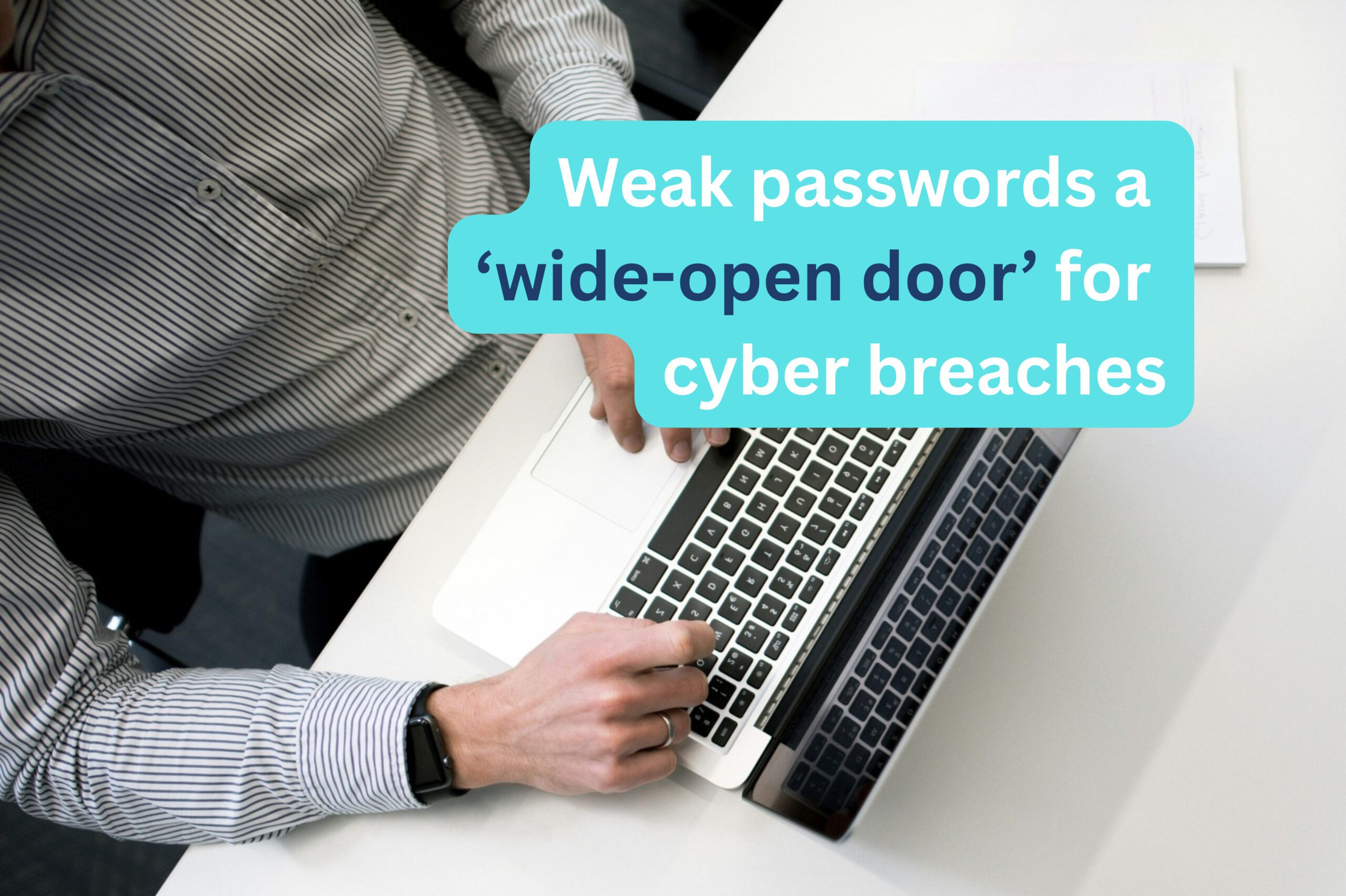
It provided what the ICO described as a “wide-open door” for cyber criminals.
The ransomware attack resulted in the theft of personal information relating to approximately 3,300 people, the majority of whom were children. What makes the incident particularly striking is that it wasn’t an attack involving really sophisticated or advanced malware techniques. The attackers reportedly just exploited a weak password, old account that was no longer required, and lack of routine account review and removal processes.
These are exactly the types of risks that organisations of every size need to be aware of and managing, especially with AI supercharging the abilities of cyber criminals.
Password Security: The Hidden Risk of Password Reuse
Poor password habits remain widespread. Research published in 2026 found that, amazingly, “123456” is still one of the most commonly used passwords globally. With “admin”, “password” and similar variations, all continuing to appear in leaked datasets.
The same research showed that weak password habits are not limited to any particular age group or demographic. It looks like convenience is simply winning over security for many users.
Password reuse presents an even greater challenge. It’s thought around 65% of people reuse passwords across multiple accounts. Analysis of more than 19 billion exposed passwords found that 94% were reused or duplicated.
For SMEs, this creates significant risk. A breach that occurs on an unrelated third-party service can quickly become a business problem if employees reuse the same password across personal and business accounts.
Criminals are routinely using automated credential-stuffing attacks to test stolen usernames and passwords against Microsoft 365, email platforms, cloud services and business applications. With weak passwords often exploited as an initial access vector for ransomware attacks.
Read our guide: How to tackle employee password fatigue.
Cybersecurity for SMEs Starts with the Basics
Cybersecurity can often feel overwhelming, especially for SME businesses trying to balance limited time and resources against an ever-increasing threat landscape. However, prevention is always better than cure, as incidents such as the “Password1” breach highlight.
This is exactly why schemes such as Cyber Essentials exist. The UK Government-backed certification is designed to help organisations implement basic security controls that can protect against the most common cyber threats.
Rather than focusing on complex or expensive solutions, it provides a practical framework covering areas such as access controls, secure configuration, software updates, malware protection and firewalls.
Increasingly, Cyber Essentials is being used not just as a security benchmark, but as evidence of good cyber hygiene and cyber resilience. It can help SMEs demonstrate their commitment to security, meet supply chain requirements, support compliance efforts and build trust with customers, partners and suppliers.
If you’re new to the scheme, read our guide explaining What is Cyber Essentials and why is it important for SMEs?
You can also find out what’s changed in our Cyber Essentials 2026 update.
Strong cybersecurity is built on strong fundamentals.
So, what should organisations be doing to promote better cyber hygiene and reduce potential risk?
Account Management
- Removing unused accounts
- Disabling dormant test accounts
- Reviewing user permissions
- Applying least-privilege access principles
Password Security
- Enforcing strong password policies
- Preventing password reuse
- Using password managers where appropriate
- Monitoring for exposed credentials
Identity Protection
- Enabling multi-factor authentication (MFA)
- Reviewing sign-in activity
- Applying conditional access controls
- Monitoring suspicious login attempts
Why Weak Passwords Are Particularly Dangerous for Microsoft 365
Microsoft 365 accounts are a common target for cyber criminals because they often provide access to email, files, Teams conversations, SharePoint data and business applications through a single identity.
This means a compromised password can potentially expose large amounts of sensitive business information. Implementing MFA, conditional access policies and regular account reviews can significantly reduce this risk.
Are passkeys the answer?
One reason password-related attacks remain so common is that passwords themselves are becoming increasingly difficult to manage securely. People have more accounts than ever before, creating pressure to use memorable credentials.
This is one of the reasons why major technology providers, including Microsoft, Google and Apple, are accelerating the move towards passkeys.
Passkeys can provide a more secure alternative to traditional passwords because they:
- Cannot be guessed
- Cannot be reused across services
- Are resistant to phishing attacks
- Offer a simpler sign-in experience
For many organisations, passkeys represent a significant step towards reducing identity-related cyber risk. You can learn more about them in our blog: The Future is Passwordless: Understanding Passkeys
While passkeys are gaining momentum, many organisations will continue to operate mixed environments where passwords and passkeys coexist. This means businesses still need strong password policies, MFA, identity management and regular account reviews as part of a layered approach to security.
Cybersecurity Is About Process, Not Products
One of the most important takeaways from the BBC article is that breaches rarely happen because of a single failure.
They tend to occur when several small issues combine, including:
- Weak passwords
- Forgotten accounts
- Missing MFA
- Poor access reviews
- Lack of security ownership
Individually, these issues may seem minor. Together, they can open up opportunities that attackers are only too happy to exploit.
Technology alone is not enough. Cyber security is ultimately a people issue. It requires ongoing education and awareness, as well as strong processes and regular reviews, as part of a proactive approach to risk management.
Regular security awareness training can help employees recognise phishing attempts, avoid password reuse and identify suspicious activity before it develops into a security incident.
SME Password Security Checklist
✅ Use strong, unique passwords
✅ Enable MFA on all accounts
✅ Remove dormant accounts
✅ Review administrator privileges
✅ Use a password manager
✅ Monitor for compromised credentials
✅ Consider passkeys where available
✅ Conduct regular access reviews
How Dragon Helps SMEs Strengthen Cybersecurity
At Dragon, we work with SMEs across a wide range of sectors, helping them reduce cyber risk, improve resilience and build stronger security foundations.
We understand that many businesses do not have the resources for a dedicated in-house cybersecurity team. That’s why our approach focuses on delivering practical, manageable and cost-effective security improvements that reduce risk while supporting business growth.
Our cybersecurity services help organisations with:
- Microsoft 365 security
- Identity and access management
- Security best practice
- Cyber Essentials preparation and certification
- Employee awareness
- Ongoing security monitoring and compliance
Cybersecurity-as-a-Service
We introduced Cybersecurity-as-a-Service to provide SMEs with a simpler way to stay secure and compliant. The service is designed to help organisations strengthen their Microsoft 365 security, simplify Cyber Essentials certification and maintain ongoing compliance through continuous support and guidance.
The need for this support has never been greater with 43% of UK businesses reportedly having experienced a cyber breach or attack in the previous 12 months, affecting an estimated 600,000+ organisations nationwide.
Talk to us to find out more: call us on 0330 363 0055 or email info@dragon-is.com.
In summary
The fact that a password as simple as”Password1″ could contribute to a significant data breach in 2026 may seem surprising. But perhaps it shouldn’t be.
As cyber threats become more sophisticated, it is easy to focus on the latest attack techniques, AI-powered threats and emerging vulnerabilities. Yet it often comes down to getting the basics right and simple cyber hygiene. Developing a cyber secure culture is key.
If you’d like help strengthening your Microsoft 365 security, preparing for or maintaining Cyber Essentials certification, or reducing cyber risk across your organisation, our cyber security experts are here to help.
Frequently Asked Questions
What Causes Most Cyber Attacks on SMEs?
Contrary to popular belief, many cyberattacks do not start with sophisticated hacking techniques. They begin with common security weaknesses such as weak passwords, password reuse, missing multi-factor authentication (MFA), unpatched systems and phishing emails.
For SMEs, attackers often look for the easiest route into an organisation. A weak password protecting a forgotten account can be just as valuable to a cybercriminal as a technical vulnerability.
What is a weak password?
A weak password is one that can be easily guessed or cracked by attackers. Examples include “123456”, “12345”, “password”, “admin” and other predictable combinations. It also includes passwords tied to personal information that is easily discoverable, such as nicknames and surnames, favourite football teams, and the names of pets.
Why is password reuse dangerous?
If a password is exposed in a breach on one service, attackers can use automated tools to test the same credentials against email accounts, Microsoft 365, banking services and business systems. This technique is commonly known as credential stuffing.
What is credential stuffing?
Credential stuffing is an automated cyberattack where criminals use usernames and passwords obtained from previous data breaches to try and access other online accounts. If passwords have been reused across multiple services, attackers may be able to gain access to business email accounts, Microsoft 365 environments and cloud applications without needing to crack the password itself.
How often should passwords be changed?
Modern cybersecurity guidance has evolved. Rather than forcing frequent password changes, organisations are increasingly encouraged to use strong, unique passwords, enable multi-factor authentication and monitor for signs of compromise. Passwords should always be changed immediately if there is any suspicion they have been exposed or reused following a breach.
How can I tell if my business passwords have been compromised?
Many compromised passwords appear in publicly available breach databases after cyberattacks on websites and online services. Security monitoring tools can help identify exposed credentials and alert organisations when employee accounts may be at risk, allowing passwords to be changed before attackers can exploit them.
Are passkeys more secure than passwords?
In most scenarios, yes. Passkeys eliminate many of the risks associated with passwords, including guessing, reuse and phishing attacks, while also making sign-in easier for users.
What is multi-factor authentication (MFA)?
Multi-factor authentication (MFA) adds an additional layer of security when signing in. Alongside a password, users must provide a second form of verification such as an authentication app notification, text message code or biometric check. Even if a password is stolen, MFA can significantly reduce the likelihood of unauthorised access.
Does my SME need Cyber Essentials?
For many SMEs, the answer is yes. Cyber Essentials is a UK Government-backed certification scheme designed to help organisations protect themselves against the most common cyber threats, including phishing, malware, ransomware and password-related attacks.
Increasingly, customers, suppliers and public sector organisations are asking businesses to demonstrate that they take cybersecurity seriously, and Cyber Essentials provides recognised, independent evidence of this. In some sectors and public sector supply chains, certification may even be a requirement when bidding for contracts.
Beyond compliance, Cyber Essentials helps organisations establish strong security fundamentals, including secure access controls, multi-factor authentication, patch management and device security. For many SMEs, it provides a practical and cost-effective framework for improving security while reducing business risk.
How long does it take to achieve Cyber Essentials certification?
Most SMEs can achieve Cyber Essentials relatively quickly if the right controls are already in place. The timescale depends on your current security posture, but an initial assessment can quickly identify any gaps that need addressing before certification. Dragon can help guide you through the process and simplify the journey to certification.
How can Dragon help improve our cybersecurity?
Dragon helps SMEs strengthen their security through Microsoft 365 protection, identity and access management, Cyber Essentials preparation, security monitoring, compliance support and employee awareness training. Our Cybersecurity-as-a-Service offering provides ongoing guidance and protection without the cost of building an in-house cybersecurity team.